> ## Documentation Index
> Fetch the complete documentation index at: https://docs.inworld.ai/llms.txt
> Use this file to discover all available pages before exploring further.
# Intent Node Demo
This demo showcases how to use the `IntentNode`.
## Run the Template
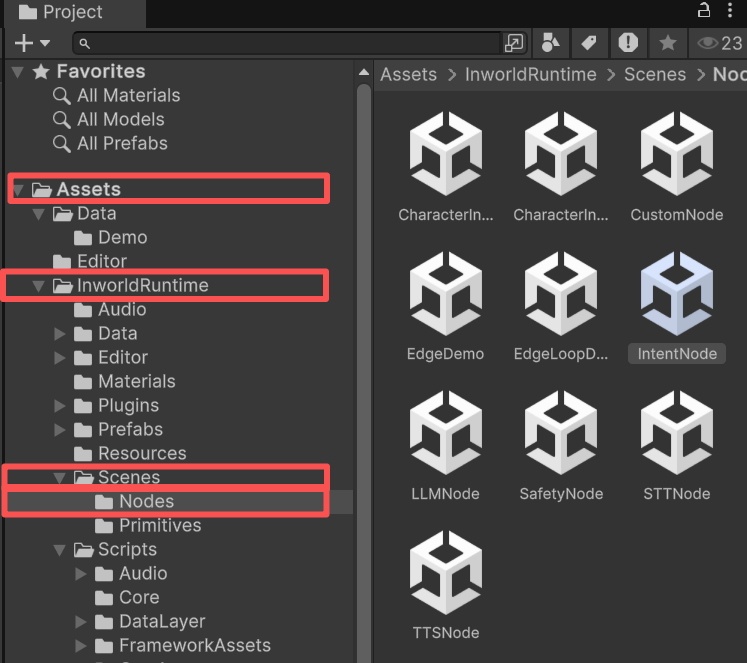
1. Go to `Assets/InworldRuntime/Scenes/Nodes` and play the `IntentNode` scene.
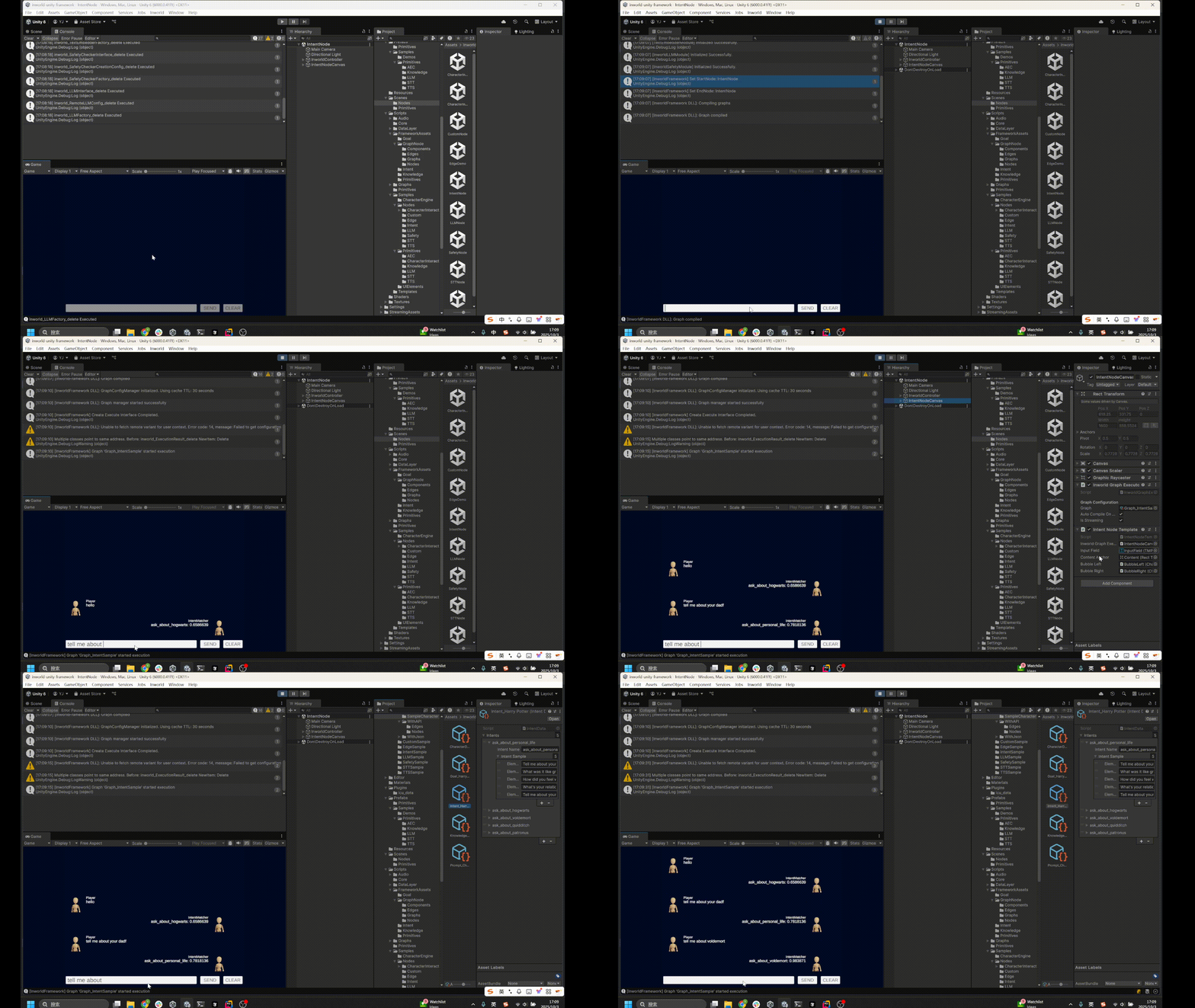
 2. Once the graph is compiled, enter text.
The system finds the closest intents from the intent list and provides a similarity score (0 = lowest, 1 = highest).
2. Once the graph is compiled, enter text.
The system finds the closest intents from the intent list and provides a similarity score (0 = lowest, 1 = highest).
 ## Understanding the Graph
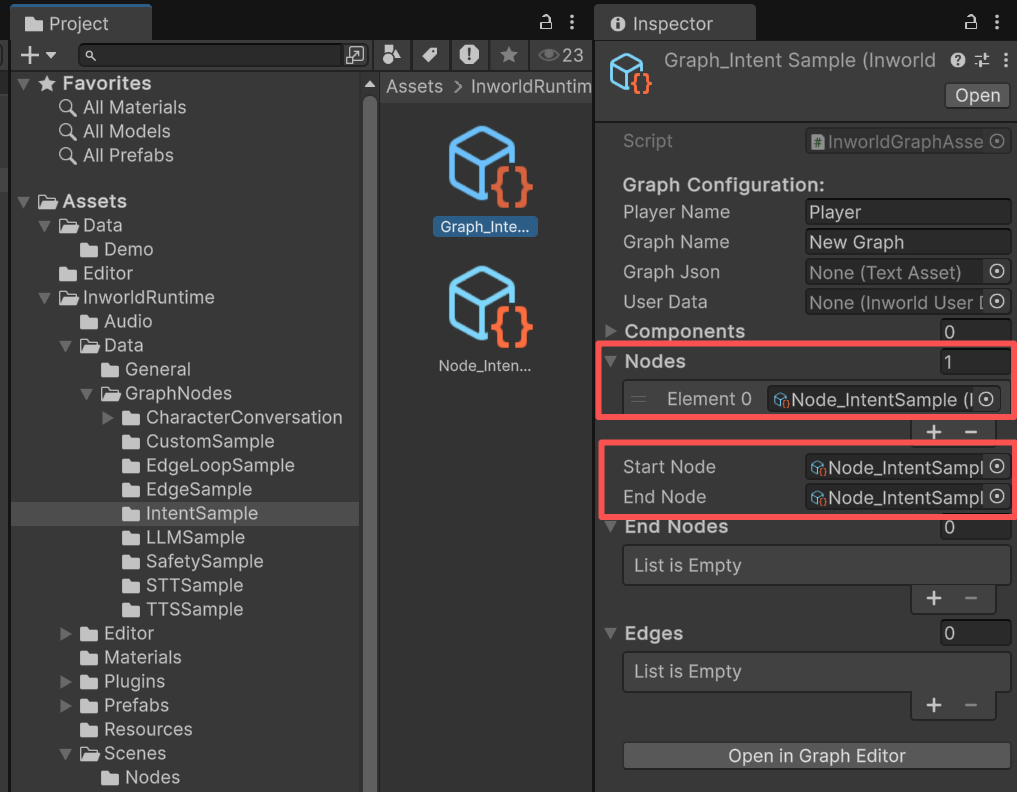
`IntentNodeCanvas` contains an `InworldGraphExecutor` whose graph asset includes only a single `IntentNode`.
The graph is very simple. It contains a single node, `IntentNode`, with no edges.
`IntentNode` is both the `StartNode` and the `EndNode`.
## Understanding the Graph
`IntentNodeCanvas` contains an `InworldGraphExecutor` whose graph asset includes only a single `IntentNode`.
The graph is very simple. It contains a single node, `IntentNode`, with no edges.
`IntentNode` is both the `StartNode` and the `EndNode`.
 ### IntentData
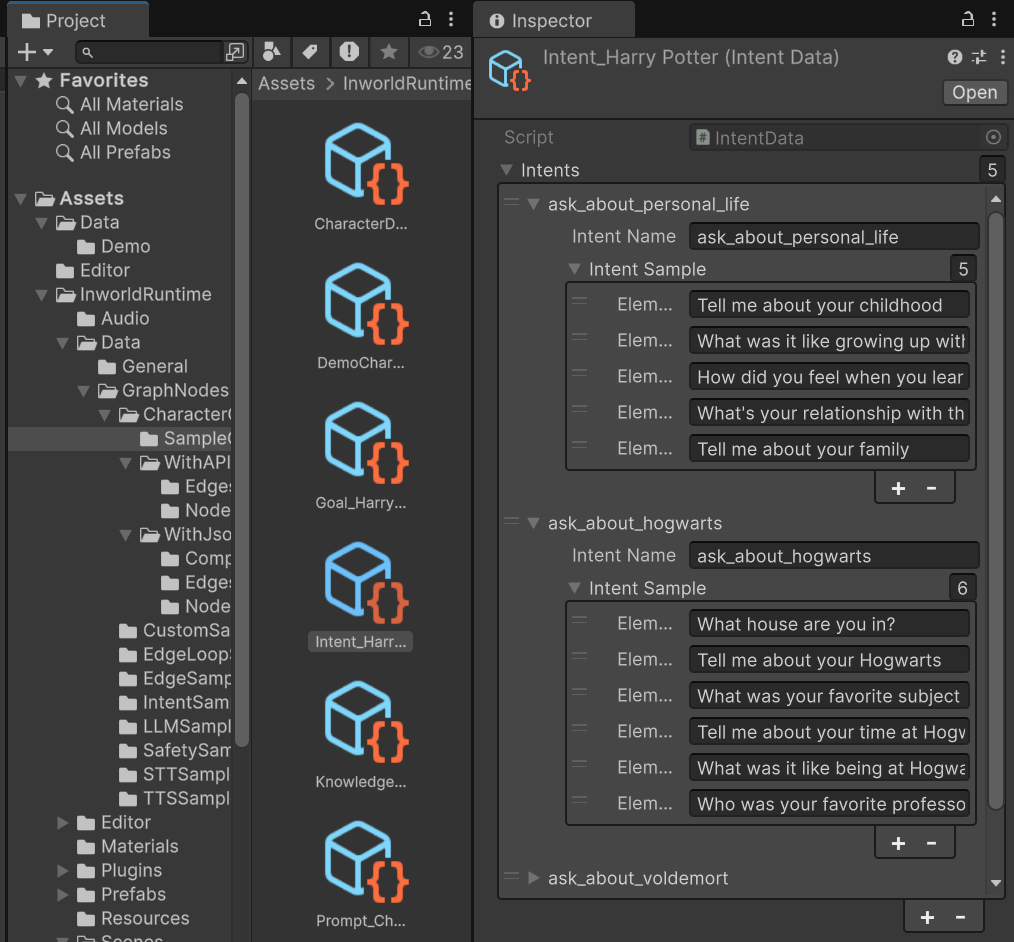
The `IntentData` is defined directly within the `IntentNodeAsset`.
### IntentData
The `IntentData` is defined directly within the `IntentNodeAsset`.
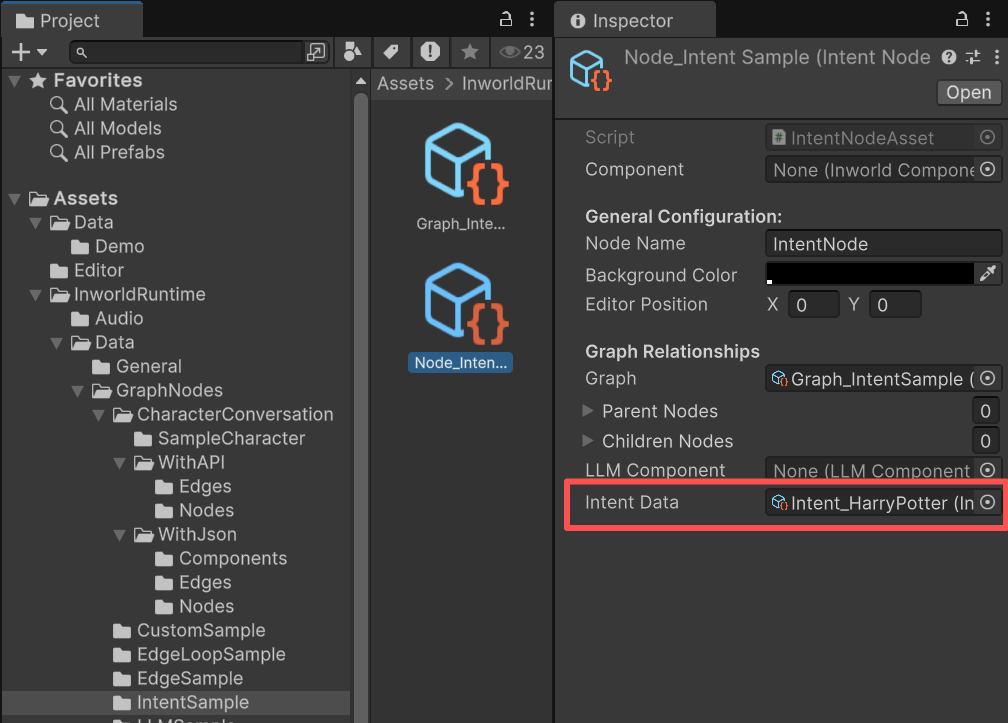 The data structure works as follows: each topic includes several `IntentSample` entries to help the AI module recognize those categories.
 ### InworldController
`InworldController` includes only one primitive module: `TextEmbedder`.
### InworldController
`InworldController` includes only one primitive module: `TextEmbedder`.
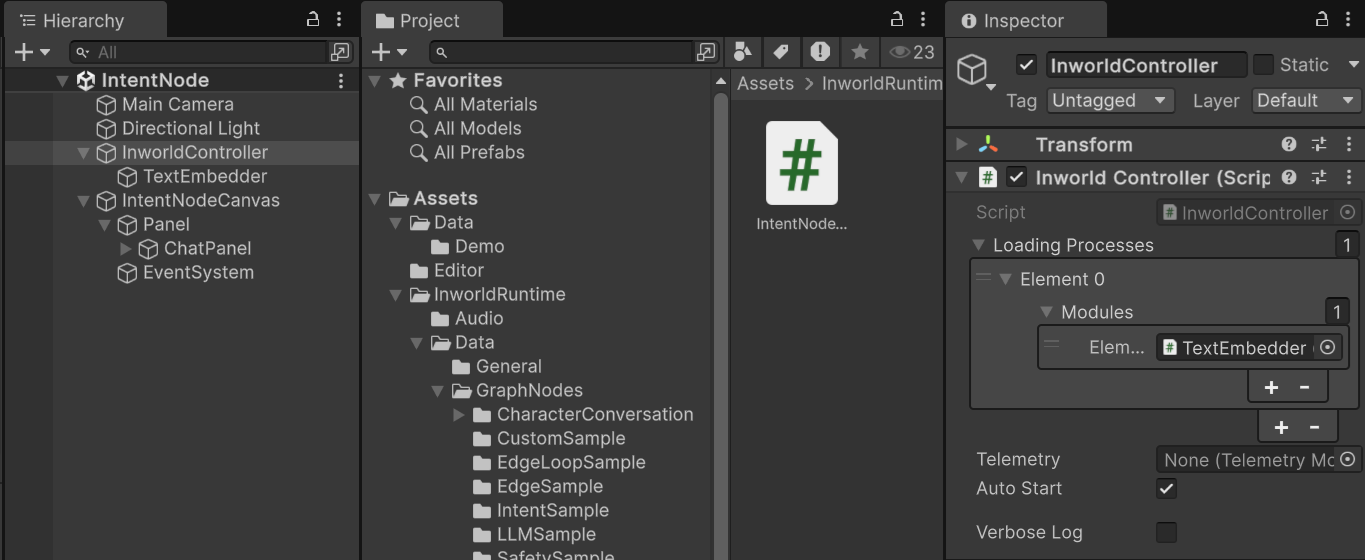 This is because `IntentNode` requires a `TextEmbedder` interface during `CreateRuntime()`.
```c# IntentNodeAsset.cs theme={"system"}
public override bool CreateRuntime(InworldGraphAsset graphAsset)
{
m_Graph = graphAsset;
ComponentStore componentStore = new ComponentStore();
componentStore.AddTextEmbedderInterface(NodeName, InworldController.TextEmbedder.Interface as TextEmbedderInterface);
InworldCreationContext creationContext = new InworldCreationContext(componentStore);
IntentNodeCreationConfig creationCfg = GetNodeCreationConfig() as IntentNodeCreationConfig;
IntentNodeExecutionConfig executionCfg = GetNodeExecutionConfig() as IntentNodeExecutionConfig;
Runtime = new IntentNode(NodeName, creationContext, creationCfg, executionCfg);
return Runtime?.IsValid ?? false;
}
```
### Workflow
1. When the game starts, `InworldController` initializes its only module, `TextEmbedderModule`, which creates the `TextEmbedderInterface`.
2. Next, `InworldGraphExecutor` initializes its graph asset by calling each component’s `CreateRuntime()`. In this case, only `IntentNode.CreateRuntime()` is called, using the created `TextEmbedderInterface` as input.
3. After initialization, the graph calls `Compile()` and returns the executor handle.
4. After compilation, the `OnGraphCompiled` event is invoked. In this demo, `IntentNodeTemplate` subscribes to it and enables the UI components. Users can then interact with the graph system.
```c# IntentNodeTemplate.cs theme={"system"}
protected override void OnGraphCompiled(InworldGraphAsset obj)
{
foreach (InworldUIElement element in m_UIElements)
element.Interactable = true;
}
```
5. After the UI is initialized, pressing `Enter` or the `SEND` button sends the input text to the graph.
6. Calling `ExecuteGraphAsync()` eventually produces a result and invokes `OnGraphResult()`, which `IntentNodeTemplate` subscribes to in order to receive the data.
```c# IntentNodeTemplate.cs theme={"system"}
protected override void OnGraphResult(InworldBaseData output)
{
MatchedIntents matched = new MatchedIntents(output);
if (matched.IsValid)
DisplayMatchedIntents(matched);
else
{
Debug.LogError(output);
}
}
```
This is because `IntentNode` requires a `TextEmbedder` interface during `CreateRuntime()`.
```c# IntentNodeAsset.cs theme={"system"}
public override bool CreateRuntime(InworldGraphAsset graphAsset)
{
m_Graph = graphAsset;
ComponentStore componentStore = new ComponentStore();
componentStore.AddTextEmbedderInterface(NodeName, InworldController.TextEmbedder.Interface as TextEmbedderInterface);
InworldCreationContext creationContext = new InworldCreationContext(componentStore);
IntentNodeCreationConfig creationCfg = GetNodeCreationConfig() as IntentNodeCreationConfig;
IntentNodeExecutionConfig executionCfg = GetNodeExecutionConfig() as IntentNodeExecutionConfig;
Runtime = new IntentNode(NodeName, creationContext, creationCfg, executionCfg);
return Runtime?.IsValid ?? false;
}
```
### Workflow
1. When the game starts, `InworldController` initializes its only module, `TextEmbedderModule`, which creates the `TextEmbedderInterface`.
2. Next, `InworldGraphExecutor` initializes its graph asset by calling each component’s `CreateRuntime()`. In this case, only `IntentNode.CreateRuntime()` is called, using the created `TextEmbedderInterface` as input.
3. After initialization, the graph calls `Compile()` and returns the executor handle.
4. After compilation, the `OnGraphCompiled` event is invoked. In this demo, `IntentNodeTemplate` subscribes to it and enables the UI components. Users can then interact with the graph system.
```c# IntentNodeTemplate.cs theme={"system"}
protected override void OnGraphCompiled(InworldGraphAsset obj)
{
foreach (InworldUIElement element in m_UIElements)
element.Interactable = true;
}
```
5. After the UI is initialized, pressing `Enter` or the `SEND` button sends the input text to the graph.
6. Calling `ExecuteGraphAsync()` eventually produces a result and invokes `OnGraphResult()`, which `IntentNodeTemplate` subscribes to in order to receive the data.
```c# IntentNodeTemplate.cs theme={"system"}
protected override void OnGraphResult(InworldBaseData output)
{
MatchedIntents matched = new MatchedIntents(output);
if (matched.IsValid)
DisplayMatchedIntents(matched);
else
{
Debug.LogError(output);
}
}
```